
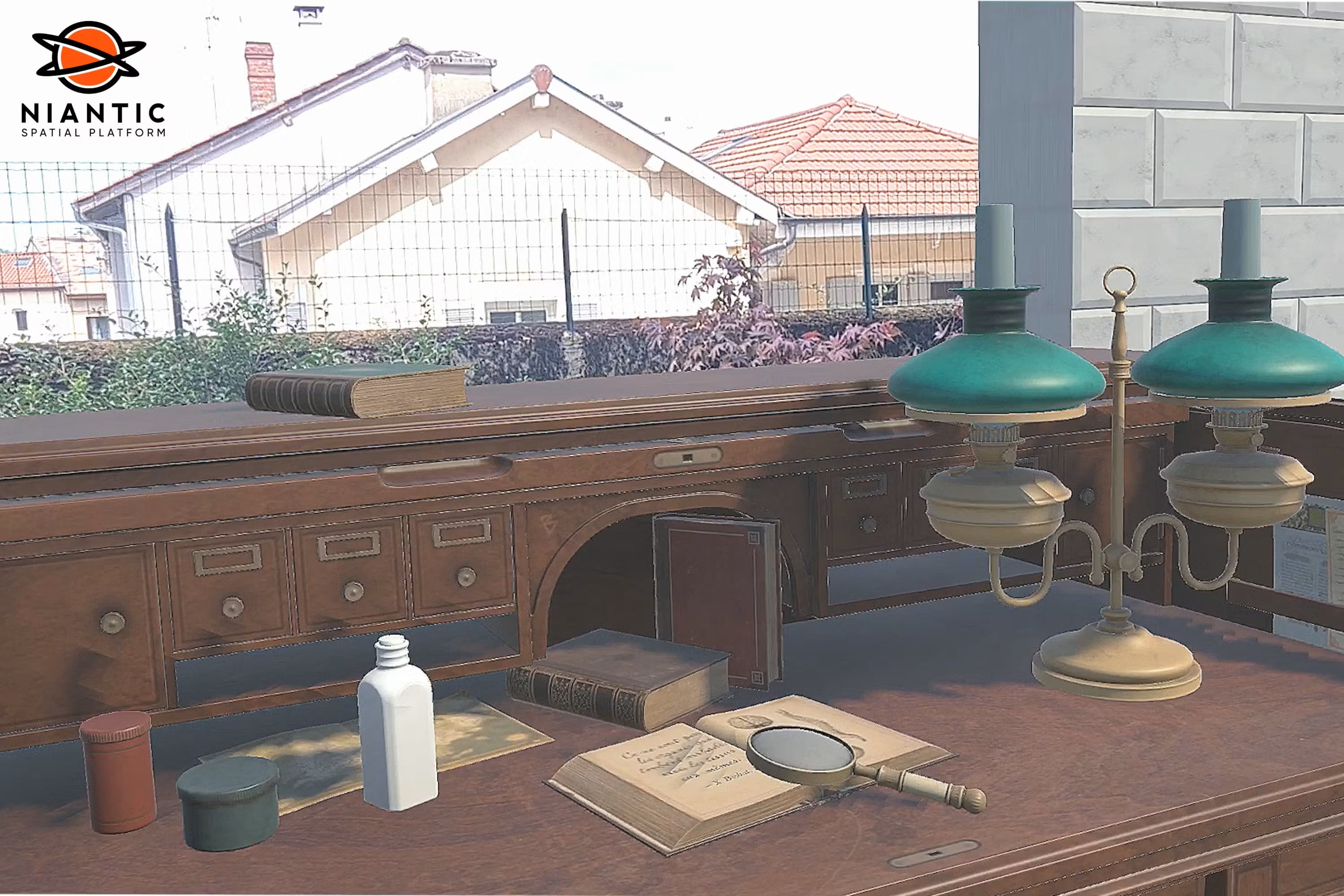
GPS is good enough for navigation. It's nowhere near good enough for placing a virtual object precisely on a physical landmark.
We ran a targeted R&D project to evaluate the Niantic Spatial Platform and its Visual Positioning System - specifically how well it holds up in practice when you need centimetre-level AR accuracy on a standard smartphone.
Why VPS matters
GPS typically delivers accuracy to within a few metres. That's fine for getting you to a street corner. It's not fine if you're trying to anchor a virtual sculpture precisely on a plinth, or overlay information exactly onto a specific architectural feature.
VPS (Visual Positioning System) changes this. By recognising the visual geometry of a scanned physical location, it can position virtual objects with accuracy measured in centimetres rather than metres - and maintain that position consistently across devices and sessions.
The test setup
The study was led by Noa, our mobile developer, with field support from Mael, an intern. We scanned multiple locations using Scaniverse on Android - a significant shift from the iOS-only workflow that previously dominated Niantic's tooling.
Rather than relying on LiDAR (available only on certain iOS devices), Scaniverse on Android uses photogrammetry - reconstructing 3D geometry from a series of overlapping photographs taken from different angles. The result is a point cloud that becomes a mesh ready for use in Unity.
What we scanned
For the study we scanned a range of structures - statues, columns, architectural features and smaller decorative elements - capturing a variety of surface types and scales to understand where the system performs best and where it struggles.
Unity integration
Once a scan was activated as a VPS point by Niantic, we imported the resulting mesh into Unity and built an AR scene around it. Our goals were simple: how quickly does the system lock on, and how well does it hold position?
Results were positive. Virtual objects stayed stably aligned at centimetre-level precision. VPS lock-on consistently happened within 1 to 3 seconds - fast enough to preserve the sense of immersion.
Where this leads
Niantic sold their gaming business to Scopely in early 2024 and have since refocused as Niantic Spatial Inc., centred on geospatial AI. The platform is maturing rapidly.
For client projects, this technology opens up concrete possibilities - location-based AR experiences, interactive heritage and cultural installations, training applications tied to specific physical environments. If you're exploring what this could look like for your organisation, we're happy to talk through the possibilities.